
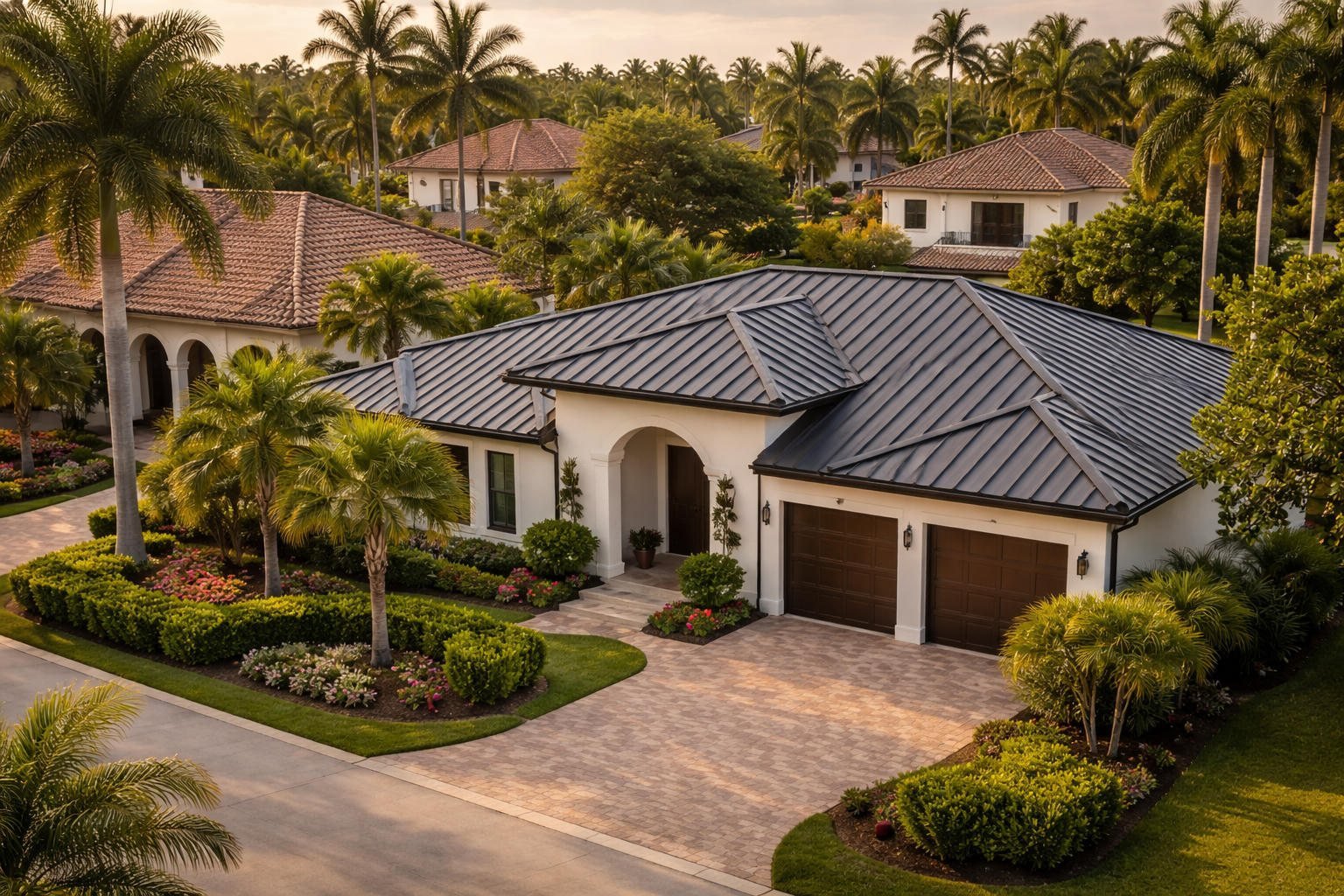
Get the insurance quote before the offer
In the Northeast or Midwest, insurance is a closing-week errand. In Flagler County it can be the reason you walk away. Bind a homeowners (wind) quote and a flood quote on the specific address before you waive contingencies. A round number from a Facebook group is not a quote.
If three independent agents will not write the house — roof too old, no wind mitigation, VE zone, prior claims — that is information. The listing price does not include a policy you cannot buy.
Age of the roof
Florida carriers care about the roof more than the kitchen. Many will not write a new policy, or will non-renew, once a shingle roof is past a stated age — often 15 years, sometimes less, sometimes 25 with proof. Metal and tile have different clocks. The seller’s memory is not a date.
Get the permit history from Palm Coast or Flagler County, the invoice, and photos of the decking if it was an overlay. An overlay on a 1998 deck is not a 2022 roof. If you are buying in season, assume a reroof will be priced like everyone else just remembered they needed one.
- Ask for the year, the material, who installed it, and whether it was a full tear-off.
- A wind-mitigation inspection will photograph the roof from the ground and, often, the attic.
- Budget the replacement now if the roof is inside five years of a carrier cutoff.
Wind mitigation
A wind-mitigation inspection (OIR-B1-1802 in Florida) is a form, not a vibe. It documents roof shape, covering, deck attachment, roof-to-wall connections, opening protection, and secondary water resistance. Credits on that form can move a wind premium by thousands of dollars a year.
Hip roofs generally credit better than gables. Clips, wraps, and double wraps in the attic are the quiet gold on 1970s ITT houses. If nobody has been in the attic with a flashlight, you do not know.
Impact windows and shutters
Opening protection is how the house keeps its roof in a hurricane: impact glass, or shutters / panels that actually get closed. A garage door that was never upgraded is an opening. So is the sliding glass on the lanai.
Impact windows are expensive and they help. Accordion or colonial shutters help if someone is home to close them — useless on a snowbird house in September unless you have a local with a key and a checklist. Do not tape windows. Tape does not stop glass.
Elevation
The finished-floor elevation against the FEMA map is a flood-premium input, not a sunset view. An elevation certificate (EC) is the document. Some inland lettered streets sit well; some canal lots and Hammock / A1A parcels do not. Two houses on the same street can differ.
Ask for the EC. If there isn’t one, budget to have it done before you argue with a flood quote. “We’re not on the beach” is not an elevation.
Previous flooding
FEMA claims history, seller disclosure, and neighbors who have actually lived through a wet year will tell you more than a sunny showing. Palm Harbor canals can take water when the Intracoastal rises. Southwest lakes have their own flood planning area. Parking-lot puddles after a summer storm are not the same as water in the garage.
National Flood Insurance Program claims are not always obvious in a listing. Have your agent pull what they can, and walk the lot after a hard rain if you are here in summer.
Seawall and dock
A canal lot without a sound seawall is a repair, not a lifestyle. Seawalls fail quietly, then all at once. Cap condition, panel bowing, return walls, and whether the canal actually reaches navigable water are separate questions. A pretty dock photo is not a hydrographic survey.
Lifts, pilings, and electric at the water are their own permits and their own insurance conversation. If you want a boat behind the house, confirm depth, bridges, and HOA/city rules before you fall in love with the kitchen.
Permitting
Unpermitted additions, enclosed lanais, and “the last owner was handy” show up in Flagler the same way they show up everywhere — except here they also affect wind mitigation and insurance. Pull the city or county permit file. Palm Coast and Flagler Beach are different counters.
A new dock, a seawall cap, impact windows, a reroof: if it isn’t in the file, assume you will pay to make it legal or to insure around it.
Flood insurance
A homeowners policy does not cover flood — including storm surge, canal overflow, and a lot of the water that people describe as “the storm drain backed up.” NFIP and private flood are separate. There is usually a waiting period (often 30 days). A named storm is too late.
Lenders in AE and VE zones will require it. Cash buyers can skip it and own the entire loss. Flagler’s NFIP averages sit below South Florida; AE canal lots and VE beach rows do not. Price the zone on the parcel, not the city.
Is a policy even obtainable?
“Reasonable” is the word. A house you can buy but cannot insure at a premium that still fits the month is not a deal. Citizens Property Insurance (the state insurer of last resort) exists because the private market walked away from some roofs and some ZIP codes. Citizens is a real option here; it is not always the cheap option, and it has its own rules.
If the only binder you can get is a surplus-lines policy with a huge hurricane deductible and a roof exclusion, that belongs in the offer math — or it belongs in a walk-away.
The inspection stack
A general home inspection is necessary and not sufficient. On a coastal house you also want, in some combination: a 4-point (electrical, plumbing, HVAC, roof — required by many carriers on older homes), a wind-mitigation inspection, a roof inspection, and an elevation certificate if flood is in play. Mold and sewer scopes are the usual extras on 1970s ITT stock.
- 4-point: can the carrier even write the house?
- Wind mitigation: what credits exist today?
- Roof: years left, and is it a tear-off?
- Elevation certificate: flood premium, not a view.
Questions for the agent — yours, and the insurance agent
Do this on the specific address, not “Palm Coast in general.”
- What is the roof year and material, and will you write it?
- What hurricane deductible (often a percentage of Coverage A) am I accepting?
- Is flood required, recommended, or being skipped because someone is optimistic?
- Citizens, admitted carrier, or surplus lines?
- Any prior claims that will follow the house?
- What happens at renewal if I do not replace the roof on your timeline?